
XGIMI Aura 3 Max review
Does it replace the living-room television?
An ultra-short-throw projector that copes with living-room light and, after calibration, comes close to reference in SDR greyscale and colours. Where the limits lie in contrast and HDR is shown by the measurements.

Contents
Summary
The Aura 3 Max is a living-room projector that can be calibrated like a home cinema device. Out of the box its picture is noticeably blue-tinted. After calibration, deviations in greys and colours are barely noticeable in the picture (avg ΔE 1.05 and 1.01). The menu controls are enough for that, because the projector responds very stably to every correction. The black level is extremely good for a UST projector, even without DBLE. Its weaknesses show with bright light sources in night scenes, with HDR midtones that are too dark, and with DBLE, which deepens black further but tints dark tones reddish.
What calibration delivers Average ΔE deviation, visible from 3 · Factory calibrated
- Greyscale
- ΔE Factory 11.2 → calibrated 1.1
- Colours
- ΔE Factory 11.0 → calibrated 1.0
- Skin tones
- ΔE Factory 15.3 → calibrated 1.0
- HDR greyscale
- ΔE Factory 11.5 → calibrated 2.1
What I like
- Very stable and precisely adjustable to neutral, entirely without a 3D LUT: after white balance and CMS, SDR greyscale at avg ΔE 1.05, Rec.709 colours at avg ΔE 1.01
- RGB laser with a very large gamut: 96.2% of BT.2020 and 99.6% of DCI-P3 (xy area)
- HDR greyscale neutral after 2-point white balance (avg ΔE 2.11), soft roll-off with detail right up to the peak
- High light output even when calibrated, practical with ambient light
- Full CMS and 11-point white balance, all controls act cleanly
- Very low input lag in game mode, 4K 120 Hz via HDMI 2.1 (according to XGIMI the first UST projector)
- Quiet in operation, high-quality build, wood-front design that catches the eye in a living space
What I don't
- DBLE lowers the black level but tints dark greys reddish (at 40%: 4,787 K, ΔE 13.3)
- HDR darker than intended: the EOTF drops below the reference from 40% PQ, at 50% it is 35% short on luminance
- HDR colours oversaturated, even after white balance (HDR content colours avg ΔE 10.4)
- HDR10 and Dolby Vision without 11-point white balance, correction only via 2-point white balance and CMS
- No lens shift; geometry and image position rely on placement and keystone correction alone
Terms briefly explained
- ΔE 2000
- A measure of the distance between the measured and the correct colour. Below 1 counts as reference; below 3 a deviation is usually not noticeable in the picture.
- Greyscale
- The brightness steps from black to white. They should stay free of colour cast, otherwise the whole picture tips towards blue or red.
- Gamma
- Defines how quickly the picture brightens from black to white. Too flat and shadows look grey and washed out; too steep and they sink into black.
- D65 and kelvin (K)
- D65 is the standardised white for films and series, around 6,500 K. Higher values look bluish, lower ones reddish.
- Rec.709, DCI-P3, BT.2020
- Standardised colour spaces: Rec.709 for SDR television and Blu-ray, DCI-P3 for cinema and HDR mastering, BT.2020 as the largest container for UHD.
- SDR and HDR
- SDR is the classic video signal. HDR additionally carries very bright highlights and more colours, for instance as HDR10 or Dolby Vision.
- CMS
- Colour management in the picture menu: hue, saturation and brightness of each primary colour can be corrected individually.
- 3D LUT
- A correction table for every single colour, more involved than a CMS. The Aura 3 Max does not need one.
- Spectroradiometer and colorimeter
- The spectroradiometer splits the light into its wavelengths and serves as the reference. The faster colorimeter is matched to it for every unit.
- cd/m² and lumens
- cd/m² is luminance, i.e. how bright the screen appears from the seat. Lumens state how much light the projector emits in total; the manufacturer's figure in ISO lumens follows the ISO 21118 standard.
- EOTF and roll-off
- The EOTF defines how bright each HDR signal value is displayed. The roll-off gently flattens the curve before peak brightness so that bright details do not burn out.
- On/off contrast
- Compares a fully white with a fully black picture and describes how deep a continuously dark scene gets; mixed scenes with bright light sources do not reach this value.
- DBLE
- Dynamic Black Level Enhancement: dims the laser in dark scenes so that black looks deeper.
Setup & Installation
With the Aura 3 series XGIMI sends two ultra-short-throw projectors into the race in autumn 2026 that on paper, for the first time, stand level with the top dogs from Hisense, Samsung and AWOL: RGB triple laser, dual dynamic iris with DBLE, Dolby Vision and, according to XGIMI as the first UST projector ever, 4K at 120 Hz via HDMI 2.1. The Max is the flagship with 5,700 ISO lumens for an RRP of $4,999; the Pro shares platform and optics with it and saves $1,000 (more on that below). XGIMI has not yet named a euro price: sales start on 20 October 2026 via Kickstarter, with early-bird prices well below the RRP (details in the conclusion) and shipping expected from December 2026; the retail price will follow later. Five years after my review of the Samsung LSP9T, which made the breed presentable in the living room, the question arises anew: is a UST projector by now not just big, but also right?
A UST projector trades ceiling mounting for geometry discipline: the distance to the wall sets the image size, the sideboard must stand exactly parallel, and every unevenness in the wall shows up as a wavy line. The Aura 3 Max offers automatic keystone correction and optical autofocus for this; both are usable but do not replace manual fine adjustment.
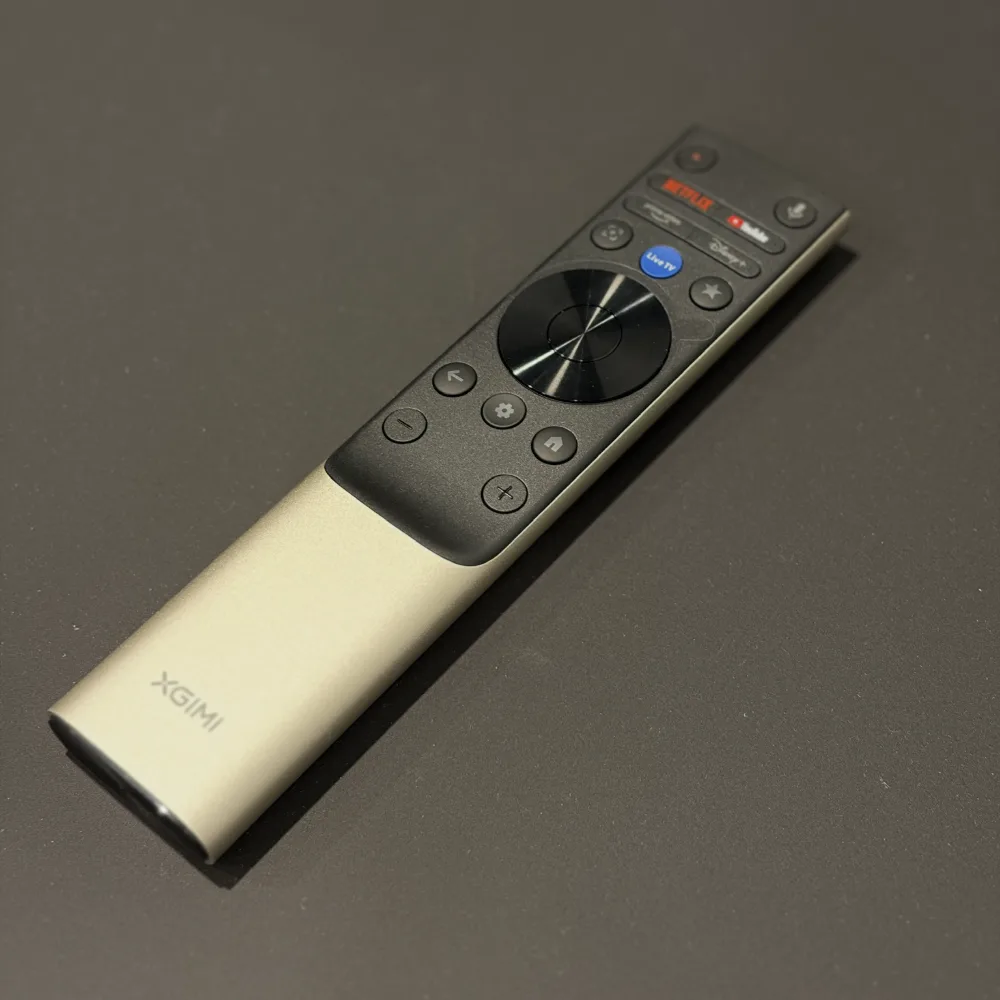
My advice from the setup: invest time in alignment until the picture sits straight on the screen without digital correction. Every step of keystone correction rescales the image and costs sharpness, as the Motion & Sharpness section shows on the line pattern. After first switch-on, Google TV guides you through setup; Netflix runs natively and certified, so the Aura 3 Max needs no additional streaming box. The remote brings direct buttons for the major services and sits well in the hand; it needs no more praise than that: it does what it should.
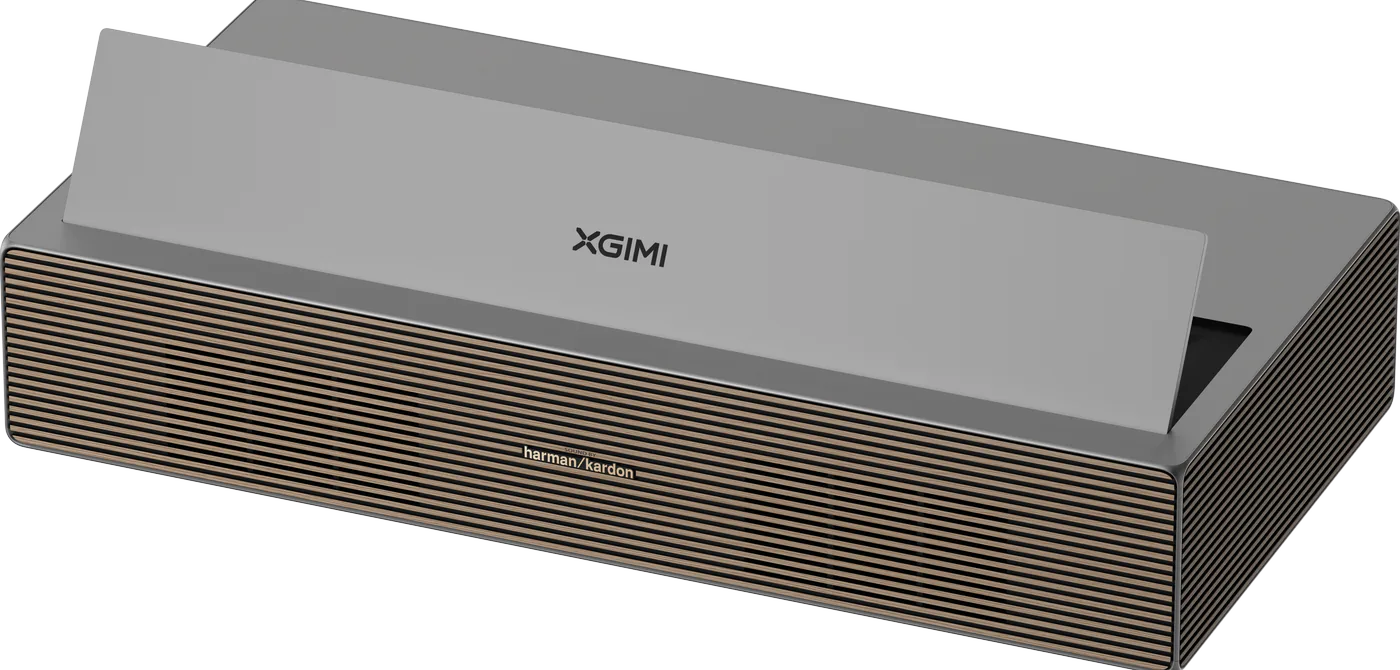
Key figures according to XGIMI
- Light source
- RGB triple laser
- Refresh rate
- 4K 120 Hz via HDMI 2.1 (according to XGIMI the first UST projector with 120 Hz)
- Connections
- 3 × HDMI 2.1 (1 × eARC), 3 × USB-A, optical digital output, 3.5 mm audio output, LAN
- Throw ratio
- 0.163:1 (120″ at 20.3 cm from the wall)
- Image size
- 80″ – 150″
- Dimensions
- 60 × 38 × 15 cm (W × D × H)
- Weight
- 12.5 kg

Throw distance & Image size
 Open the graphic at full size
Measurement details
Dimensions according to XGIMI. C diagonal, X image width, Y image height, D distance from unit to screen, H bottom edge of the image above the surface. Tolerance ± 2–3 cm; the height for 110″ and 120″ is obscured in the source.
Screen in this review: NothingProjector Fresnel ALR 120″, gain 1.2, over 95% ambient light rejection according to the manufacturer. A Fresnel screen focuses the UST projector's light towards the seat and absorbs light from above and the sides. That brings the biggest contrast gain with living-room light but makes the picture viewing-angle dependent; how much is covered under Contrast & Luminance. All other measurements are on-axis from the picture centre.
Picture in practice
What the measurements further down prove can be seen in a film. After calibration, skin tones in “Dune: Part Two” look neutral instead of cool and pink, and the desert keeps detail in the highlights. “The Batman” shows the limit, and it is not black: the night scenes stay deep, but bright light sources in the picture slightly brighten their surroundings.
What surprised me on the first film night is the calm of the picture. After calibration, lawns, sky and skin have exactly the saturation the film intends, without the garishness many laser projectors use to vie for attention out of the box. The reason is further down in the measurements: a ColorChecker average of ΔE 1.01 is a figure I otherwise know from calibrated OLED televisions, not from a living-room projector. Add to that a black level that is extremely good for a UST projector, even without DBLE: the typical grey veil of this breed is absent, dark scenes keep their depth, and the detail just above black stays clean.
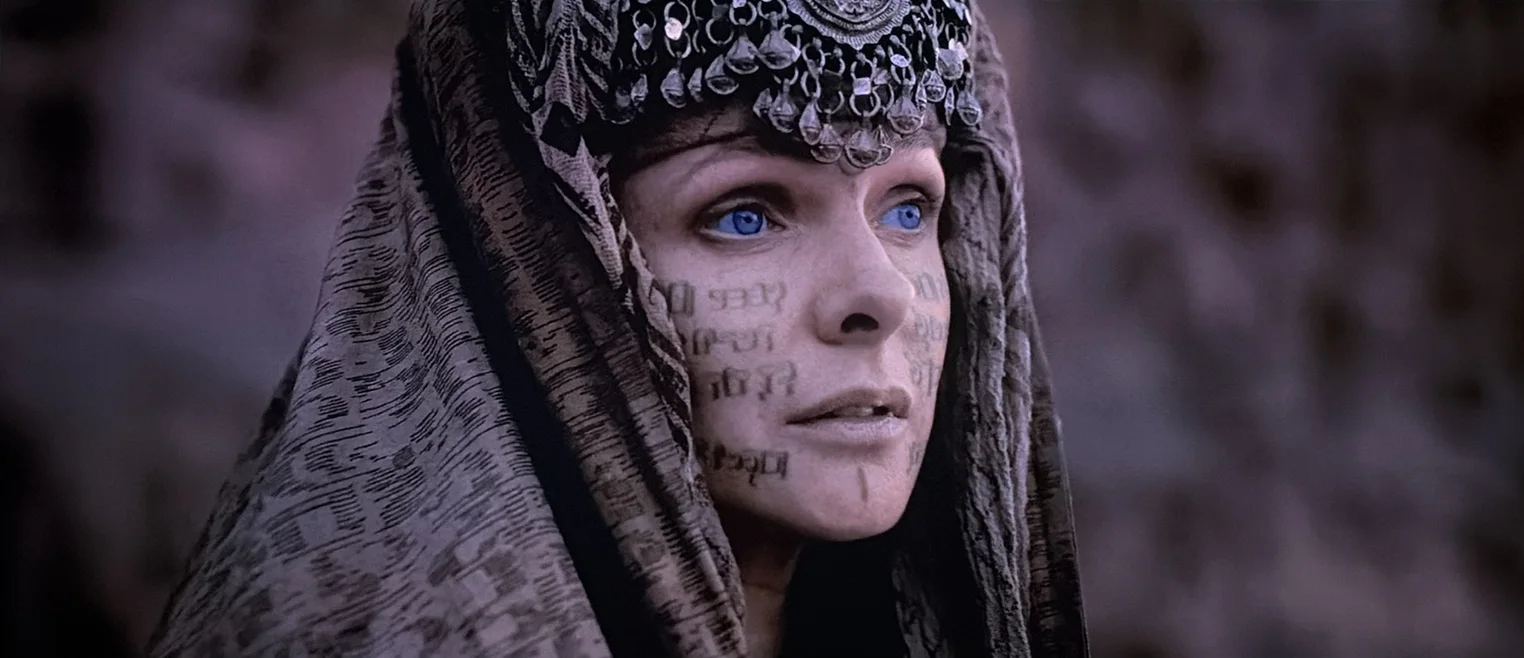

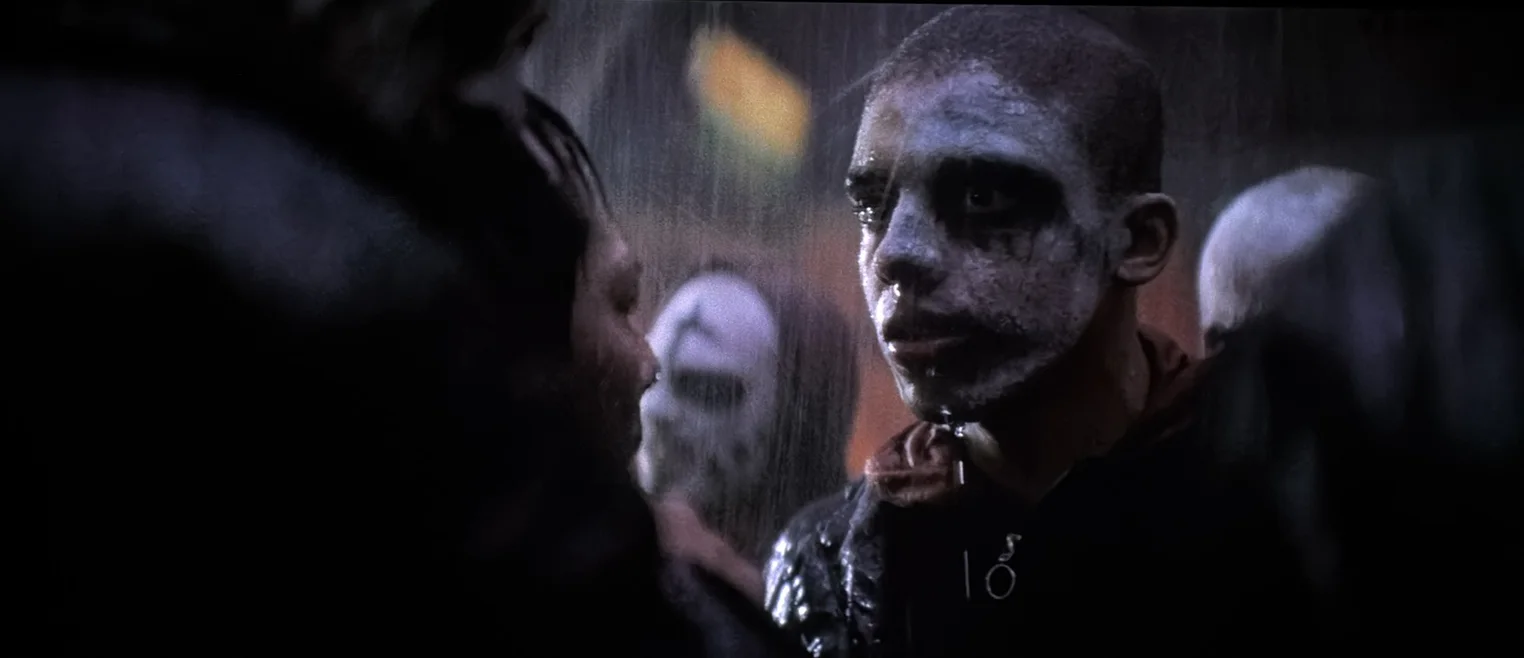
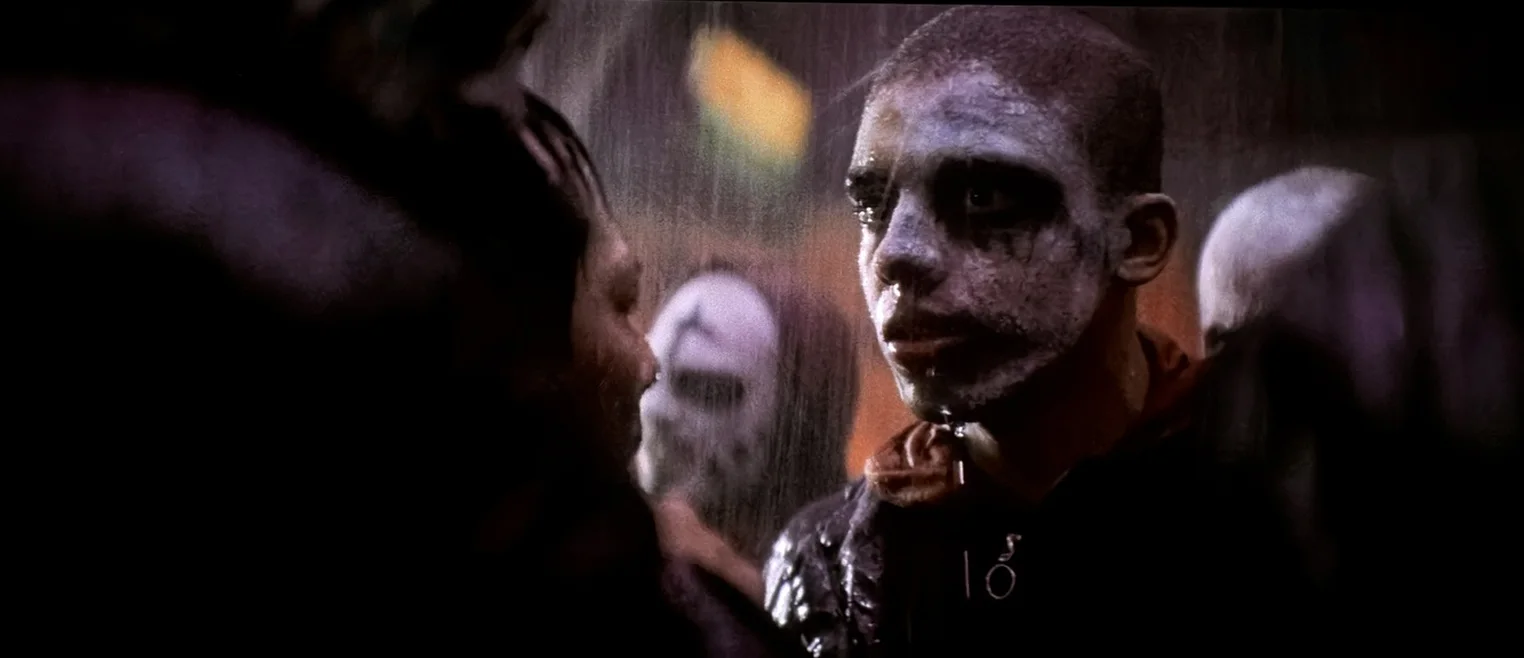
In HDR the tuning shows two sides. The desert in “Dune: Part Two” keeps detail right into the brightest dunes because the roll-off runs softly up to the peak and nothing burns out. In return the midtones sit darker than mastered: the EOTF drops below the reference from 40% PQ, at 50% it is 35% short on luminance. In a film that means: interiors and faces look a touch more subdued than on a television; HDR has less pop on the Aura 3 Max than its light output allows. Here I would like XGIMI to deliver a firmware that brings the curve closer to the reference.
With living-room light and a Fresnel screen the picture stays contrasty, colours lose a little saturation. That is the use case the combination of UST optics and Fresnel screen is built for: a conventional projector on a white screen loses far more contrast at the same ambient light, because the screen reflects room light in all directions.
For context, a comparison from my own experience: the XGIMI Titan Noir Max has been running in my home cinema for several months, and for a dedicated, light-controlled room it is the better choice. The Aura 3 Max shows its strengths there too, its black level and calibrated colours go a long way, but I clearly see its purpose in the living space: UST optics, Fresnel screen and ambient light are the combination it is built for, and there it performs better than anything I have measured in this breed so far.
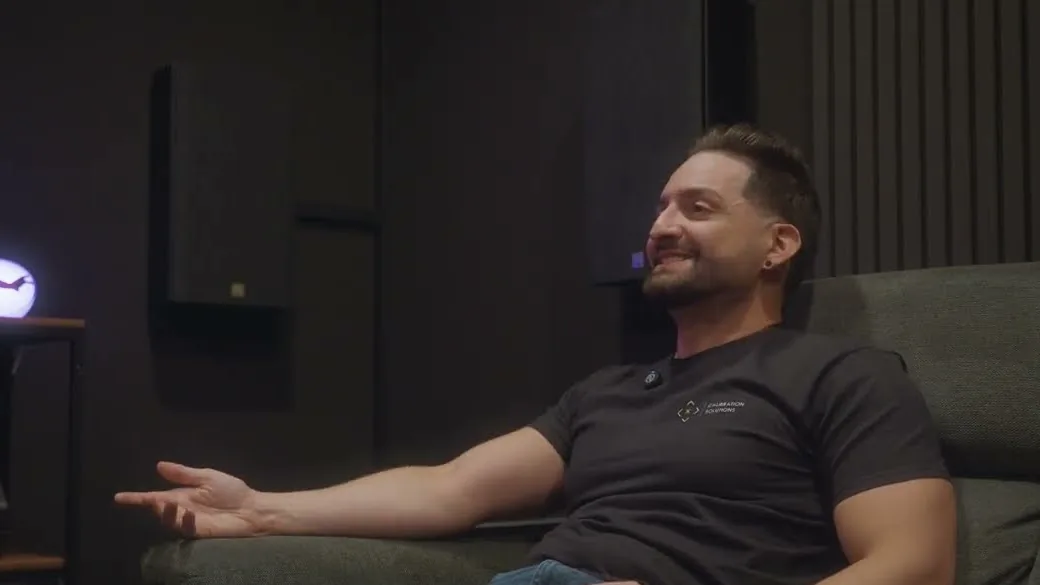
I first saw the Aura 3 Max at IFA 2026, and it was clear right away: I wanted to test it myself. XGIMI then visited me at home with the review unit for the series “The Aura Life”, from the cinema room to the living room.
Further observations
- Rainbow effect
- Even without the “Anti-RBE” setting, a very sensitive eye perceives it only minimally, if at all; with “Anti-RBE” active it disappears completely for me.
- Edge sharpness
- Absolutely sharp right to the edge: fine lines and menu text stay clean even in the corners, focus never drops off. I have not seen it done better on a UST projector.
- Speckle
- Noticeably less than on other RGB laser projectors, which is partly down to the Aura 3 Max's laser spectrum; not distracting on the Fresnel screen at seating distance.
- Dynamic iris and DBLE
- The dynamic iris can only be switched on or off: in a bright living room I would use it, in a light-controlled room I prefer aperture f4.0 with an adjusted laser level; for measurement it stays off. Since the FPGA update DBLE acts noticeably faster and lowers the black level, but tints dark greys reddish (measurement under Contrast & Luminance); off for calibration.
- Audio latency
- Internal speakers without audible offset; via eARC to an AV receiver lip-sync with 40 ms correction.
Picture out of the box
Eight picture modes are available: “Standard”, “Film”, “Vivid”, “Game”, “Sport”, “Filmmaker”, “ISF Day” and “ISF Night”. “Standard” is the factory default. Its picture is bright and punchy but noticeably blue-tinted, with midtones too bright and oversaturated colours. In return it delivers 161 cd/m², a good quarter more light than the calibrated mode.
The figures behind it: at 10,813 K at 100% white, the white point sits far above D65. Blue rises to around 117% towards white, red falls to around 93%. The greyscale averages ΔE 11.22 (max 16.94), gamma 2.22 instead of 2.4. The mode renders colours in the full native gamut, according to Calman 190.6% of the Rec.709 area (ColorChecker avg ΔE 11.05, skin tones avg 15.35).
Better even without a meter: These settings improve the picture immediately, regardless of calibration.
- Picture mode: “ISF Night”
- The most neutral factory mode: white close to D65 and greyscale averaging under ΔE 4 out of the box, while “Standard” is strongly blue-tinted (values in the picture modes table).
- MEMC: off for films
- Motion smoothing produces artefacts and the soap-opera effect from “Medium” upwards.
- Dynamic iris: Living room “On”, dark room “Off”
- The iris only knows on or off. In a bright living room I would definitely use it; in a light-controlled room I recommend aperture f4.0 with an adjusted laser level instead.
- DBLE: Living room on, dark room off
- It deepens black but tints dark greys reddish. I would use it in the living room, not in a dark room.
- Keystone correction: to zero
- Digital correction costs sharpness; better to align the unit squarely.
- Game mode: set per HDMI input
- Only then does input lag drop to TV level.
| Picture mode | Greyscale ΔE avg | Context | Lumens | White (cd/m²) | CCT |
|---|---|---|---|---|---|
| Standard | 11.22 | Factory default, strongly blue-tinted | 1,675 | 161 | 10,813 K |
| Film | 3.82 | Neutral, gamma 2.24 | 1,690 | 162 | 6,686 K |
| Vivid | 11.38 | Brightest mode, strongly blue-tinted | 1,960 | 189 | 11,359 K |
| Game | 13.06 | Like Standard, blue-tinted | 1,615 | 156 | 11,893 K |
| Sport | 12.44 | Like Standard, blue-tinted | 1,655 | 159 | 11,629 K |
| Filmmaker | 3.69 | Neutral, gamma 2.39 | 1,650 | 159 | 6,786 K |
| ISF Day | 6.15 | Neutral, flat gamma 1.97 for bright rooms | 1,660 | 160 | 6,725 K |
| ISF Night | 3.53 | Most neutral factory mode, starting point of the calibration | 1,175 | 113 | 6,294 K |
| Calibrated | 1.05 | ISF Level III, ISF Night mode, 11-point | 1,320 | 127 | 6,562 K |
Table 1:Measurement: all values at aperture f4.0; with the aperture fully open at f2.0 the luminous flux roughly doubles. Luminous flux extrapolated from the white luminance at screen centre onto the screen area (procedure under Methodology), white luminance measured off the screen at centre. CCT at 100% white, greyscale ΔE averaged over 5–100%. Highlighted: the starting mode of the calibration and its result.
SDR measurements
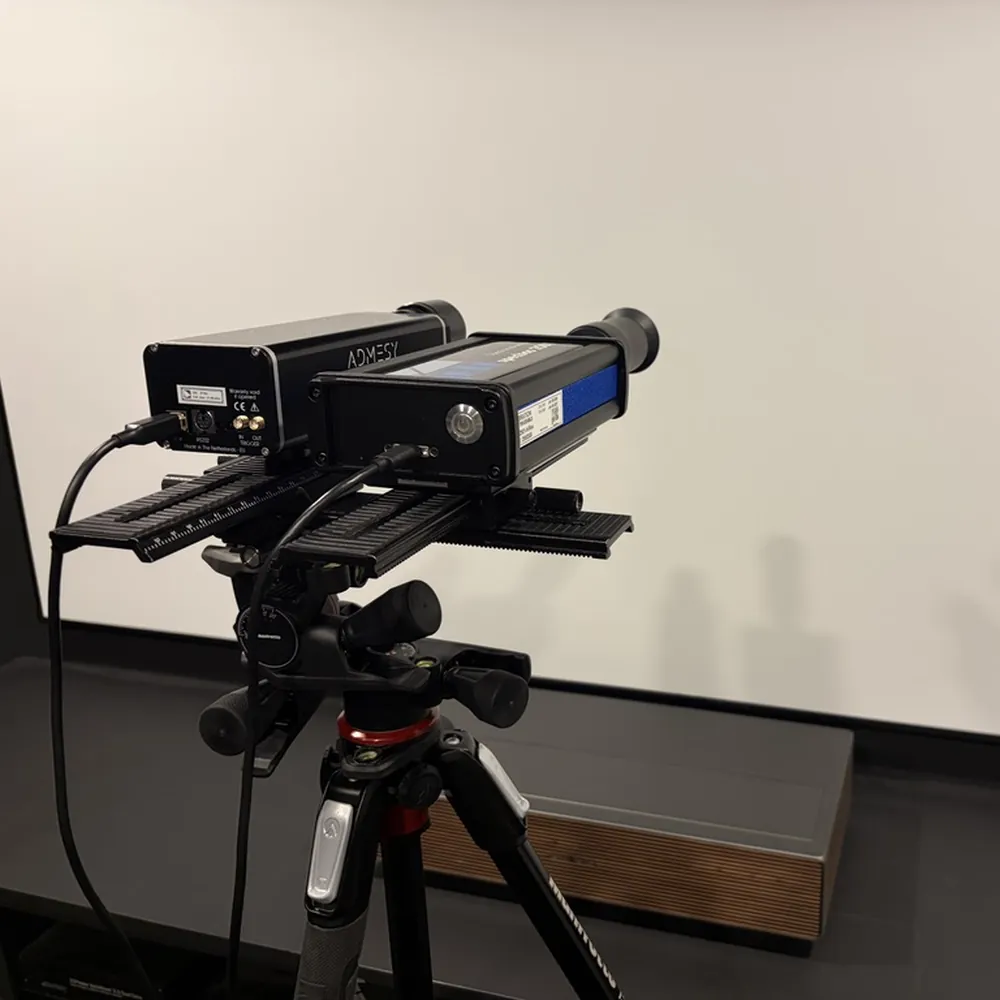
Measurements are taken off the screen with the Admesy Prometheus colorimeter, profiled against the JETI Specbos 2501 HiRes with 2 nm resolution as reference. All values refer to Rec.709 with D65 white point and gamma 2.4. “Factory” is the “Standard” mode as delivered, i.e. the picture straight out of the box. “Calibrated” is the “ISF Night” mode after 2-point and 11-point white balance and CMS correction, without a 3D LUT. Every chart shows both measurement runs on the same scale: purple for factory, turquoise for calibrated. The red-shaded area is where deviations become noticeable in the picture. “Measurement details” below each chart opens the exact values.
Greyscale: blue-tinted out of the box
The greyscale shows whether grey stays free of colour cast from black to white. That is the basis for neutral white and natural skin. In a film that means: out of the box, white walls, clouds and shirts look bluish; calibrated, neutral.
Measurement details
ΔE 2000 per grey level from 0 to 100%. Factory: “Standard” mode, 21 points in 5% steps, at most 16.94 at 100%. Calibrated: “ISF Night” mode, 14 points (5% steps up to 30%, 10% steps above), at most 1.69 at 80%. The 3 threshold is a guide above which deviations usually become visible in the picture; below 1 counts as reference. Whether a ΔE is visible depends on the subject and luminance. All ΔE charts use the same scale from 0 to 20.
Factory
Calibrated
Measurement details
Shares of red, green and blue per grey level, read from Calman's RGB balance curves (D65 = 100%, accurate to about ±0.5%). Out of the box the curve ends at 95% because the screenshot cuts off the last point; calibrated, the three lines partly overlap, and hidden channels carry the value of the line above. Out of the box (“Standard” mode) blue deviates most: 117% at 95%. Calibrated (“ISF Night” mode) green is furthest off: 101% at 90%. Values below 10% are uncertain because of the low luminance.
Gamma: too flat out of the box
Gamma determines how bright shadows and midtones appear. When it is right, the picture looks neither washed out nor too dark. In a film that means: out of the box, night scenes look milky; calibrated, they keep their mood.
Measurement details
Gamma per grey level against the 2.4 target that is usual for darkened rooms. Gamma that is too low brightens shadows and midtones, the picture looks washed out. 0 and 100% are omitted because gamma is not defined there. Out of the box (“Standard” mode): 2.15 to 2.29. Calibrated (“ISF Night” mode): 2.24 to 2.39.
Spectrum: three narrow laser lines
The spectrum shows which colours make up the projector's white. It explains why a laser produces such vivid colours and why it is so hard to measure.
A lamp or LED spreads its light over many wavelengths; an RGB laser bundles it into three lines, each only a few nanometres wide. That is the reason for the huge colour gamut, and it is the reason an ordinary meter fails here: a spectrometer that samples light only in steps of 5 or 10 nm catches such a narrow line only by half or shifts it, and immediately white point and colour coordinates are wrong. That is why I measure laser projectors exclusively with a high-resolution spectroradiometer, here the JETI Specbos 2501 HiRes with 2 nm resolution, and profile the colorimeter against it. The same spectrum also explains why the Aura 3 Max shows noticeably less speckle than other RGB laser projectors: speckle arises when laser light of the same colour interferes with itself on the rough screen surface. The purer the line, the stronger the graininess; the more closely spaced wavelengths a line contains, the weaker it is. XGIMI's laser lines are visibly broader than a pure single wavelength, and this width noticeably dampens speckle.
Measurement details
Spectrum of the white field in “Filmmaker” mode, measured off the screen with the spectroradiometer. Main lines: blue at 465 nm, green at 526 nm, red at 641 nm. A standard colorimeter measures well off the mark with light this narrow-band; that is why it is matched against the spectroradiometer on exactly this unit before calibration.
Whether a profile holds is decided not by the meter but by the cross-check: after profiling, the colorimeter measures red, green, blue and white once more against the spectroradiometer, and only when all four patches lie within tolerance do the values of this review stand. I place great importance on this, because otherwise any measurement on a laser is only as good as the sensor that takes it. The instruments are listed under Methodology & Transparency.
 Open the graphic at full size
Measurement details
Profile check on 4 October 2026: the colorimeter profiled for this projector measures red, green, blue and white against the spectroradiometer as reference. All four test colours lie within the NIST tolerance of ±0.001 in x and y and ±1.5% in luminance. Largest deviation 0.0009 in xy and 0.3% in Y, average ΔE 0.16, at most 0.52 at white.
Colours: huge gamut, accurate once calibrated
The colour gamut shows how saturated the projector can render colours. Colour accuracy shows whether it hits the colours intended in the film. In a film that means: out of the box, lawns and skin glow unnaturally; calibrated, they look as they did on set.
Measurement details
Native gamut in the CIE 1931 diagram against Rec.709, DCI-P3 and BT.2020: 99.6% of DCI-P3, 96.2% of BT.2020. Red and blue sit practically on the BT.2020 corners, green just inside. Only an RGB laser achieves this much gamut. SDR films use only Rec.709; the calibration confines it to that via the CMS.
Measurement details
Calculated from the measured primaries as a share of the xy area of each reference colour space. Colours as in the diagram.
| Primary | x | y | Δxy to BT.2020 |
|---|---|---|---|
| Red | 0.713 | 0.284 | 0.009 |
| Green | 0.175 | 0.779 | 0.019 |
| Blue | 0.134 | 0.051 | 0.006 |
| White | 0.306 | 0.328 | 0.007 |
Table 2:Measurement: native primaries in the CIE 1931 diagram (Calman, BT.2020 target) and their distance from the BT.2020 primary; for white, the distance from D65.
The numbers deserve a moment: 99.6% DCI-P3 and 96.2% BT.2020 are values hardly any television and no lamp projector reaches; even QD-OLED televisions stay well under 90% for BT.2020. Red and blue of the Aura 3 Max sit practically on the BT.2020 corners, only green stays just inside. The projector thus covers a very large part of the BT.2020 chromaticity area. This xy coverage describes chromaticities, not their achievable luminance; bright, highly saturated HDR colours may still require tone mapping. In SDR, Rec.709 uses only a fraction of that; there the gamut is headroom that the CMS reliably reins in.
Measurement details
ColorChecker against Rec.709 and D65: five grey levels, the 18 colour patches of the ColorChecker and the primaries and secondaries at 100%. The swatch before each name shows the target colour. Out of the box (“Standard” mode) at most ΔE 17.26 at white: the mode plays Rec.709 content in the full native gamut. Cyan, green 100% and cyan 100% exceed the scale in the Calman chart out of the box; their values are back-calculated from the Calman average. Calibrated (“ISF Night” mode) at most 3.84 at blue 100%. Only blue 100% lies above the 3 threshold. The 3 threshold is a guide above which deviations usually become visible in the picture; below 1 counts as reference. Whether a ΔE is visible depends on the subject and luminance. All ΔE charts use the same scale from 0 to 20.
Measurement details
White and 17 skin colours from the ColorChecker SG, labelled with their patch number; the swatch before each shows the target colour. Colour casts show up first in skin. Out of the box (“Standard” mode) at most ΔE 17.97 at patch 2K. Calibrated (“ISF Night” mode) at most 1.87 at patch 8I; no patch reaches the 3 threshold. The 3 threshold is a guide above which deviations usually become visible in the picture; below 1 counts as reference. Whether a ΔE is visible depends on the subject and luminance. All ΔE charts use the same scale from 0 to 20.
The colours also stay stable from dark to bright: calibrated, primaries and secondaries average ΔE 1.08. Only blue becomes less accurate in the brightest steps, matching the blue outlier on the ColorChecker. That is down to the projector's laser, not the CMS: the blue line sits so far out that the menu controls can no longer fully rein it in at high luminance. Only a 3D LUT would get that under control.
In detail: across 13 luminance steps from 5 to 100% the colours average ΔE 8.85 out of the box (max 16.98). Calibrated, blue lies above the 3 threshold in the top steps, at most ΔE 3.84 (blue 100%); magenta reaches about ΔE 2.5 there. In Calman's “75% gamut” test the colours average ΔE 0.21 calibrated, 10.16 out of the box.
What is remarkable is how little it took: white balance and CMS in the menu are enough, the Aura 3 Max does not need a 3D LUT. The projector responds stably to every correction, which makes it precisely adjustable to neutral.
HDR measurements
HDR films are mastered for highlights that no projector reaches. What matters is how it maps them down to its own brightness: do bright details keep their detail, and do the midtones stay as bright as intended? I calibrated HDR in “Filmmaker” mode with the 2-point white balance only, at 30 and 70%; “Factory” is, as with SDR, the “Standard” mode.
Measurement details
HDR10 EOTF against the PQ reference, clipped at the measured peak in each case (10% window, 120″ Fresnel ALR, gain 1.2, picture centre). The luminance axis is divided perceptually like the PQ signal: the reference becomes the diagonal, and deviations in shadows and highlights are equally easy to see. The reference is not a tone-mapping target: a good roll-off starts below the peak to preserve detail above it. Out of the box (“Standard” mode) the curve lifts dark tones, by 55% at 30%, and flattens similarly from 45%; peak 168 cd/m². Calibrated (“Filmmaker” mode, 2-point white balance at 30 and 70%) the curve lifts the darkest levels: at 5% it measures 0.138 instead of 0.061 cd/m², at 10% 0.533 instead of 0.328 cd/m². Between 20 and 35% it stays close to the reference, and from 40% it sits below it: at 50% it measures 61 instead of 94 cd/m². It only reaches its peak of 160 cd/m² at 95%.
The white balance works: afterwards the HDR greyscale sits close to D65 across the whole scale, averaging ΔE 2.11. Out of the box, the “Standard” mode pulls noticeably towards blue in HDR as well.
Measurement details
ΔE 2000 luminance-compensated: the brightness deviation from the EOTF does not count here, only the white point. Out of the box the white point becomes ever more blue-tinted with brightness: at most 16.15 at 100%, ΔE ITP averaging 19.78. Calibrated at most 4.95 at 65%, ΔE ITP averaging 2.81. The 3 threshold is a guide above which deviations usually become visible in the picture; below 1 counts as reference. Whether a ΔE is visible depends on the subject and luminance. All ΔE charts use the same scale from 0 to 20.
Factory
Calibrated
Measurement details
Shares of red, green and blue per HDR grey level, calculated from the measured chromaticity (BT.2020 primaries, D65 = 100%), not read from Calman; the chromaticities are only available to three decimal places, hence the steps in the curve. Out of the box (“Standard” mode) blue deviates most: 145% at 45%. Calibrated (“Filmmaker” mode) blue is furthest off: 82% at 10%. Values below 10% are uncertain because of the low luminance.
First the positive, and it is enormous: Gamut Rings measures 94.8% of the BT.2020 colour volume. The lightness axis is normalised to peak white; this measurement series is evaluated up to 172.5 cd/m². The figure therefore describes relative colour volume and does not establish that the projector can reproduce every colour in an HDR master at its intended luminance. Bright, saturated colours must be adapted to its limited light output. On colour accuracy in HDR, by contrast, there is still room: on the ColorMatch HDR patch set, derived from real HDR material, the colours average ΔE 10.38 after white balance, 9.16 out of the box. Most patches are slightly oversaturated, so the large gamut is not mapped quite exactly onto the target colour space in HDR. That is the rule for HDR tone mapping in the projector segment and is far less noticeable in a film than the number suggests; anyone who wants to push it to the limit has to rework this with the CMS, which is also available in HDR.
| Measurement | Result |
|---|---|
| Peak, calibrated | 160 cd/m² |
| Peak, factory | 168 cd/m² |
| Black at 0% PQ, calibrated | 0.045 cd/m² |
| Greyscale ΔE 2000 avg / max, calibrated | 2.11 / 4.95 |
| Greyscale ΔE ITP avg, calibrated | 2.81 |
| Greyscale ΔE 2000 avg / max, factory | 11.46 / 16.15 |
| HDR content colours ΔE 2000 avg / max, calibrated | 10.38 / 14.45 |
| HDR content colours ΔE 2000 avg / max, factory | 9.16 / 15.91 |
| BT.2020 colour volume (Gamut Rings) | 94.8% |
Table 3:Measurement: HDR10, 10% window, picture centre. Calibrated: “Filmmaker” mode after 2-point white balance; factory: “Standard” mode. Patch sets and Gamut Rings under Measurement methodology.
Dolby Vision: The Aura 3 Max handles Dolby Vision, but in DV mode it only unlocks the 2-point white balance and the CMS, no 11-point adjustment.
Contrast & Luminance
Contrast decides how deep black looks and how three-dimensional night scenes appear:
- On/off contrast: fully white against fully black picture. It determines how deep a continuously dark scene gets. Calibrated, the Aura 3 Max reaches 3,790:1 natively at 0.033 cd/m² black.
- Mixed scenes: Where bright light sources meet dark surroundings, the Aura 3 Max slightly brightens the surroundings. That is visible in a film, but subtle, and the price every projection optic pays compared with a television.
The illumination of my test unit is strikingly even: on a white field there is no visible brightness fall-off towards the edges or corners, not even on the 120″ Fresnel screen. The screen itself remains viewing-angle dependent, so the seats belong close to the picture centre.
| Measurement | Result |
|---|---|
| On/off native (white ÷ black), calibrated | 3,790:1 |
| Sequential without DBLE (f4.0, laser 4) | 3,722:1 |
| Sequential with DBLE (f4.0, laser 4) | 6,731:1 |
| White 100% (SDR, calibrated) | 127 cd/m² |
| Black 0% (SDR, calibrated, full field) | 0.033 cd/m² |
| Black without / with DBLE (f4.0, laser 4) | 0.027 / 0.015 cd/m² |
Table 4:Measurement: aperture f4.0, dynamic iris and DBLE off unless stated; “f4.0, laser 4” stands for aperture f4.0 and laser level 4. 120″ Fresnel screen, picture centre.
Aperture and dynamic iris: light versus contrast
The aperture is the Aura 3 Max's lever between brightness and black. Fully open at f/2 it reaches an extrapolated 3,025 lumens, but only 1,940:1; each further step costs around 30% of the light and lowers the black level. At f/5 there are still 1,110 lumens at 5,350:1; at 40 cd/m², f/7 is simply too dark for a 120″ screen. The dynamic iris lands between f/3 and f/4 with 1,840 lumens and 4,425:1: it opens in bright scenes and closes in dark ones instead of limiting the light permanently.
Only together with DBLE does the contrast jump to 35,600:1, because DBLE additionally dims the laser on black. That is a full-field value: in mixed scenes only part of the factor remains, and the next section shows the price in the shadows. For calibration I use the fixed f/4 aperture, because it best balances brightness and contrast for a light-controlled room and keeps every measurement reproducible.
Measurement details
White and black measured off the screen at centre, contrast as white ÷ black. I extrapolated the luminous flux from the white luminance onto the screen area, as for the picture modes. The fixed-aperture symbol shows the opening to scale relative to f/2. The black levels are only available to 0.01 cd/m², except f/4, which I re-measured more precisely at 0.0261 cd/m²; at f/5 and f/7 the coarse resolution noticeably affects the contrast, hence the dip after f/4. The calibration measurement at f4.0 with laser level 4 and calibrated settings gives 3,790:1 (table above).
| Setting | White (cd/m²) | Black (cd/m²) | Lumens | Contrast |
|---|---|---|---|---|
| Fixed iris f/2, fully open | 291 | 0.15 | 3,025 | 1,940:1 |
| Fixed iris f/3 | 209 | 0.06 | 2,170 | 3,483:1 |
| Fixed iris f/4 | 149 | 0.0261 | 1,550 | 5,709:1 |
| Fixed iris f/5 | 107 | 0.02 | 1,110 | 5,350:1 |
| Fixed iris f/7 | 40 | 0.01 | 415 | 4,000:1 |
| Dynamic iris only | 177 | 0.04 | 1,840 | 4,425:1 |
| Dynamic iris with DBLE | 178 | 0.005 | 1,850 | 35,600:1 |
Table 5:Measurement: full-field white and black, screen centre, contrast as white ÷ black; luminous flux extrapolated from the white luminance as for the picture modes. Highlighted: the aperture used for calibration.
DBLE: black gains, shadows turn red
DBLE (Dynamic Black Level Enhancement) dims the laser in dark scenes. Black becomes noticeably deeper and contrast rises 1.8-fold. Since the FPGA update DBLE also reacts noticeably faster to scene changes. The price: dark greys tip towards red, exactly where shadows and dark skin sit. For calibration and for films in a dark room DBLE therefore stays off.
The measurements at aperture f4.0, laser level 4: black drops from 0.027 to 0.015 cd/m², sequential contrast rises from 3,722:1 to 6,731:1. At 40% the colour temperature with DBLE falls to 4,787 K, ΔE rises from 1.9 to 13.3 and gamma to 2.70. In the near-black range the colour temperature drops to 4,916 K (without: 6,242 K). From 60% the picture stays neutral.
My recommendation: DBLE works very effectively, but in its current implementation the price, the reddish tint in the shadows, is too high for me. In a bright living room, where ambient light lifts the shadows anyway, it may stay on and brings visibly more depth; in a light-controlled room and for any calibration it stays off. XGIMI is working on an improvement; I have made these measurement results available to the manufacturer. As soon as a firmware fixes the colour drift, I will remeasure.
Measurement details
Greyscale ΔE 2000 in six steps at aperture f4.0, laser level 4, without and with DBLE, both calibrated. At 40% the colour temperature with DBLE falls to 4,787 K (without DBLE 6,489 K), the chromaticity moves from x 0.313 / y 0.328 to x 0.346 / y 0.312, i.e. towards red with a slight magenta component, and gamma rises to 2.70. From 60% the picture stays neutral. The 3 threshold is a guide above which deviations usually become visible in the picture; below 1 counts as reference. Whether a ΔE is visible depends on the subject and luminance. All ΔE charts use the same scale from 0 to 20.
Measurement details
Gamma per grey level at aperture f4.0, laser level 4, without and with DBLE, both calibrated. With DBLE the gamma rises to 2.70 at 40% (without: 2.28): DBLE dims the laser more on dark content than the curve calls for, so shadows sink. From 60% upwards both curves practically overlap. 0 and 100% are omitted because gamma is not defined there.
DBLE off
DBLE on
Measurement details
Red, green and blue shares per grey level at aperture f4.0, laser level 4, read from Calman's RGB balance curves (D65 = 100%, accurate to about ±0.5%), 100% from the bar chart; hidden channels carry the value of the line above. The axis here only spans 90 to 110%, not 50 to 150% as for SDR and HDR, so that the shift is visible. Without DBLE all three channels stay within ±1%. With DBLE, red rises to 107.8% at 40%, green drops to 97.5%, blue stays at 100.5%. From 60% upwards the channels are balanced again.
| Stimulus | CCT without DBLE | CCT with DBLE | Gamma without | Gamma with |
|---|---|---|---|---|
| 0% | 5,336 | 4,569 | — | — |
| 20% | 6,422 | 4,967 | 2.22 | 2.45 |
| 40% | 6,489 | 4,787 | 2.28 | 2.70 |
| 60% | 6,461 | 6,399 | 2.31 | 2.31 |
| 80% | 6,429 | 6,372 | 2.36 | 2.38 |
| 100% | 6,425 | 6,345 | — | — |
Table 6:Measurement: target is D65 (6,504 K) and gamma 2.4. At 0 and 100% gamma is not defined, and colour temperature at 0% is of limited significance.
Calibration & Settings
The Aura 3 Max offers everything a calibration needs: 2-point and 11-point white balance, a complete CMS with hue, saturation and luminance per colour, and a gamma selection. The controls act linearly and without jumps, which is not a given on lifestyle projectors. The only thing I would change is the gamma selection: instead of “Bright”, “Medium” and “Dark”, fixed values such as 2.2, 2.4 and BT.1886 would make more sense, then you would know before measuring which curve you get. The result below comes from these menu controls alone, without a 3D LUT: the Aura 3 Max stays so stable across the measurement runs that white point and colours can be set precisely to neutral.
This is how I proceeded: the basis is the “ISF Night” mode, out of the box at 6,294 K and greyscale averaging ΔE 3.53 the most neutral starting point. Before the white balance, brightness goes to 53: at the factory value the Aura 3 Max swallows the darkest steps just above black (black crush); only from 53 do they stay separated. Contrast sits at 49, laser level 4 at aperture f4.0. Then the 2-point white balance with gain and bias for white and the bright greys, after that the 11-point adjustment for the rest of the staircase, and finally the CMS for hue, saturation and luminance of the six primaries and secondaries. Mandatory beforehand, as with every laser: profiling the colorimeter against the spectroradiometer, because the three narrow laser lines make a generic correction useless; the ProbeMatch check under Measurement methodology shows how closely the two instruments agree afterwards (avg ΔE 0.16). Without this step you measure white points on a laser that do not exist.
Anyone who wants to try the values below on their own Aura 3 Max is welcome to. I would point out, however, that because of unit variation, screen and manufacturing tolerances they are not transferable 1:1. They are a better starting point than the factory settings, nothing more; an individual calibration, by a professional or with your own meter and the necessary know-how, remains the path to reference.
| Setting | Value |
|---|---|
| Picture mode | ISF Night |
| Laser level | 4 |
| Dynamic iris | off, aperture f4.0 |
| DBLE | off |
| Brightness | 53 (black crush below that, see text) |
| Contrast | 49 |
| Saturation | 50 |
| Sharpness | 0 |
| Colour temperature | D65 |
| 2-point white balance gain (R / G / B) | 48 / 50 / 46 |
| 2-point white balance bias (R / G / B) | 50 / 46 / 52 |
| 11-point white balance | adjusted, not published because of unit-to-unit variation |
| Gamma | Dark (equals 2.4) |
| Colour space | Rec.709 |
| CMS (hue / saturation / luminance) | adjusted, not published because of unit-to-unit variation |
| MEMC | True Cinema or off |
| All other picture enhancers | off |
Table 7:Note: picture settings in ISF Night mode. 11-point white balance and CMS are deliberately omitted: their values depend so heavily on unit-to-unit variation that on another unit they would do more harm than good. The remaining values are a starting point too, not a substitute for your own measurement.
Result: Greyscale calibrated at avg ΔE 1.05 (max 1.69), colours on the ColorChecker at avg 1.01 (max 3.84), gamma between 2.24 and 2.39 against a 2.4 target. White luminance drops from 161 cd/m² (“Standard” mode) to 127 cd/m², i.e. by 21%.
For comparison with my 2021 review of the Samsung LSP9T: there the white point could be pulled to D65, but the colours were a lost cause, because the luminance of the triple laser could not be tamed and red stayed far outside its targets. The Aura 3 Max shows how far the breed has come in five years: its CMS acts finely enough to bring the same laser source to ΔE 1.01. A dream value for any calibrator, and without a 3D LUT.
Motion & Sharpness
For films, colour is not all that counts: 24p must run smoothly, motion smoothing must not create artefacts, and on a UST projector the placement helps decide how much of the 4K resolution arrives.
I will not rehash the debate over whether a 0.47″ DMD with XPR shift delivers “true 4K”. What counts on the screen is the line pattern, and the Aura 3 Max resolves it to the single pixel right into the corners. As a picture purist I keep MEMC off for films; sports viewers may try the “Low” setting, anything above produces artefacts at edges and the soap-opera effect.
- 24p playback
- 24 Hz signals play with slight judder that even the 24p option in the picture menu does not fully remove; MEMC “Low” smooths pans but changes the film look. Checked with a panning test sequence from the Murideo.
- MEMC
- The “Low” setting smooths pans with a slight soap-opera effect; from “Medium” artefacts appear at edges. Off for films, optional for sport.
- Resolution and XPR shift
- Single-pixel line patterns in 4K are resolved right into the corners; texture stays free of visible stair-stepping.
- Keystone correction
- Digital correction rescales the image and visibly costs resolution, noticeable on the line pattern after just a few steps. Better: correct the placement, set correction to zero.
- Greyscale gradients
- 10-bit gradient without visible banding in SDR; in HDR slight banding in dark areas with DBLE active.
Gaming & Sound
The Aura 3 Max accepts 4K at 120 Hz via HDMI 2.1, according to XGIMI the first UST projector to do so. I did not measure input lag myself this time: my Leo Bodnar lag tester was not available at the time of testing, so I am taking the figures from Mondoprojos, measured with the same tester at 4K 60 Hz. They match my impression in games: with game mode enabled, input lag is on TV level. Important: game mode has to be set per input; in the film modes with MEMC active, lag rises noticeably. Figures for 1080p at 120 and 240 Hz, where XGIMI quotes 1 ms, will follow with the retest.
For context: an LG G2 OLED managed 12.9 ms in my review, the Samsung LSP9T still needed 55.6 ms in 2021, even in game mode. At 16.5 ms, 13.2 ms in boost mode, the Aura 3 Max thus plays in the league of good televisions and no longer in the projector league of back then. For shooters and racing games that is uncritical, all the more so with 120 Hz.
| Signal / mode | Input lag |
|---|---|
| 4K60, game mode | 16.5 ms |
| 4K60, game mode boost | 13.2 ms |
Table 8:Source: measurement by Mondoprojos with the Leo Bodnar 4K Lag Tester at 4K 60 Hz, firmware 0.6.238; boost switches off keystone correction. My own measurement will follow with the retest.
The Harman Kardon system fills a medium-sized room and separates dialogue cleanly. Bass stays thin; a soundbar or an AVR via eARC is the better choice for movie nights. The fan is essentially very quiet: from the seat I don't notice it in operation, and only close to the unit can you hear it pick up with the laser level. The measurement microphone confirms that impression: idle the level sits at around 34 dB(A), at laser level 10 at around 35 dB(A), so the fan barely stands out. The exception is the “High Performance” picture mode: there the fan spins up to about 55 dB(A), but the value in the table is for documentation only, because the mode overdrives the laser, the picture tips green and is simply unusable.
| Operation | Noise level |
|---|---|
| Idle | approx. 34 dB(A) |
| Laser level 10 | approx. 35 dB(A) |
| High Performance | approx. 55 dB(A) |
Table 9:Measurement: A-weighted sound level, measured with a measurement microphone, rounded. “High Performance” is in the table only to document the fan: the mode overdrives the laser, the picture tips green and is unusable.
Power consumption
At the wall, the Aura 3 Max draws 97 W at laser level 1 and 194 W at level 10 in normal operation without Light Boost, twice as much. The laser level is therefore not just the brightness control but also the power control: at the calibrated level 4 it draws around 126 W, a good third less than at full power. Anyone fighting ambient light in a living room pays for the extra brightness directly in watts.
- 971
- 2
- 3
- ≈1264
- 1365
- 6
- 7
- 8
- 9
- 19410
Laser level
Measurement details
Power consumption at the wall in normal operation without Light Boost, measured at laser levels 1, 5 and 10. The remaining levels are linearly interpolated between the measuring points, including the value of about 126 W for the calibrated laser level 4.
Differences from the Aura 3 Pro
The Aura 3 Pro is the same platform: the same RGB triple laser, the same optics, 4K 120 Hz, dual dynamic iris with DBLE, the same sound system and the same picture menus. The Max differs in three numbers: 1,600 ISO lumens more, 1,000:1 more native contrast and $1,000 more in price.
| Feature | Aura 3 Max | Aura 3 Pro |
|---|---|---|
| Light output | 5,700 ISO lumens | 4,100 ISO lumens |
| Native contrast | 8,000:1 | 7,000:1 |
| Price (RRP) | $4,999 | $3,999 |
Table 10:Source: manufacturer specifications; all other features are identical according to XGIMI. The Pro was not measured.
For calibration that means: controls, CMS and white balance should behave identically on the Pro, but the values in this review apply only to the Max. The Max's higher light output pays off with ambient light and from about 120″; in a darkened living room with 100″ the Pro delivers the same picture character at a lower price. Whether the higher native contrast is visible in practice can only be settled by measuring the Pro on the same screen.
Conclusion
Recommendation under these conditions: a Fresnel ALR screen of 100–120″, seats close to the picture centre, a living room with subdued ambient light and a calibration, because only that brings greyscale and colours close to reference. And the nice part: the black level, usually the Achilles heel of this breed, is so good on the Aura 3 Max even without DBLE that a light-controlled room is no longer a deal-breaker either. Only with HDR highlights and bright light sources in night scenes does a television keep the advantage; in return, there are no 120 inches there.
Does it replace the living-room television? For films, series and gaming at 100 to 120 inches, yes, with a Fresnel screen even in subdued daylight. The comparison with an OLED is unfair but belongs here: with HDR highlights and bright light sources in night scenes a good television keeps the advantage; around 160 cd/m² at the HDR peak is a projector figure. The black level itself, by contrast, is extremely good for a UST projector, even without DBLE. And then there is the price: for an RRP of $4,999 you get 120 inches that can be calibrated precisely with on-board controls, and anyone who jumps in as an early bird on Kickstarter pays $2,199, less than half. That is a price-performance ratio that is currently almost unbeatable in this class. Anyone for whom 4,100 ISO lumens are enough gets the same picture character with the Aura 3 Pro for $3,999.
Kickstarter instead of retail: XGIMI is launching the Aura 3 series from 20 October 2026 first via Kickstarter, with shipping expected from December 2026. Super Early Bird price for the Max $2,199 instead of the $4,999 RRP, for the Pro $1,999 instead of $3,999. Anyone who deposits €50 on xgimi.com before the launch gets an additional $200 discount; the deposit is refundable. Those who get in early get the projector for less than half the RRP. XGIMI has not yet named a euro retail price.
All in all, the Aura 3 Max is for me currently the best UST projector for the living room, and on calibratability it leaves the competition behind: a lifestyle projector that can be brought to reference level with on-board tools was unthinkable five years ago. For that it receives the Calibration Solutions “Very good” test seal, and it gets it for what it can do today, not for what a firmware might still bring. Why it does not reach a higher rating is on my wish list for the next generation: an 11-point white balance for HDR10 and Dolby Vision, an HDR curve that does not lower the midtones so far, a DBLE that holds colour temperature, and an optical lens shift so that geometry does not depend on placement alone. With these four points it would no longer be merely the best UST projector for the living room, but a home cinema projector without qualification. Until then, my view is: in a dedicated home cinema the XGIMI Titan Noir Max, which I have been running there for several months, remains the better choice; the Aura 3 Max belongs in the living room, and there no UST projector currently beats it.
Calibration as in this review
- Proof
- ISF Level III; the measurement report shows the same charts as this review.
- Scope
- Professional package: SDR with 2-point and 11-point white balance, CMS and gamma, plus HDR10.
- On site
- 1–3 hours, PDF measurement report included.
- Price
- €499 plus travel; the calculator estimates travel for your postcode, the quote is binding.
Technical data
All manufacturer specifications for reference; the key figures are listed under Setup & Installation. Whatever can be measured appears in the sections above with my own values.
| Feature | Specification |
|---|---|
| Light source | RGB triple laser |
| Resolution | 3840 × 2160 (0.47″ DMD, XPR shift) |
| Light output | 5,700 ISO lumens |
| Contrast | 8,000:1 native; dual dynamic iris + DBLE |
| Throw ratio | 0.163:1 (120″ at 20.3 cm from the wall) |
| Image size | 80″ – 150″ |
| Refresh rate | 4K 120 Hz via HDMI 2.1 (according to XGIMI the first UST projector with 120 Hz) |
| HDR | HDR10, HDR10+, Dolby Vision, HLG, IMAX Enhanced |
| Connections | 3 × HDMI 2.1 (1 × eARC), 3 × USB-A, optical digital output, 3.5 mm audio output, LAN |
| Sound | Harman Kardon, 80 W, Dolby Atmos / DTS Virtual:X |
| OS | Google TV, Netflix certified |
| Fan | < 30 dB(A) |
| Dimensions | 60 × 38 × 15 cm (W × D × H) |
| Weight | 12.5 kg |
| Price (RRP) | $4,999 |
Table 11:Source: manufacturer specifications from the XGIMI product page, as of 11 October 2026. XGIMI quotes the RRP in US dollars even in its German shop; a euro retail price had not been set at the time of writing.
Methodology & Transparency
Measurements are taken off the screen: with a spectroradiometer as reference and a colorimeter profiled against it, analysed in Calman, following the standards for SDR and HDR. Measurement points, conditions, instruments and the weighting of the score are given in detail.
Methodology in detail
- Basis: All values are measured off the screen, not at the lens. Measurement software is Calman, firmware of the test unit 0.6.238.
- SDR measurement points: Greyscale out of the box in 21 points (5% steps), calibrated in 14 points (5% steps up to 30%, 10% steps above), colours on the ColorChecker with 29 patches, skin tones on the ColorChecker SG with 18 patches, colour luminance in 13 steps from 5 to 100%, DBLE comparison in 6 steps.
- HDR: to ITU-R BT.2100 PQ in 21 steps, 10% window, ΔE luminance-compensated. The HDR content colours come from the ColorMatch HDR patch set, derived from real HDR material. Gamut Rings measures colour volume relative to BT.2020 at PQ, here up to 172.5 cd/m².
- Conditions: 30 minutes warm-up, RGB 10-bit limited range, aperture f4.0, dynamic iris and DBLE off except for the DBLE comparison, 0 lx ambient light; living-room statements at 50 lx on the screen.
- Profiling: The colorimeter is profiled afresh against the spectroradiometer for every test unit, because narrow-band laser spectra make a generic correction useless.
- Light output: extrapolated from the white luminance at picture centre: luminance × image area (265.7 × 149.4 cm) × π ÷ screen gain 1.2. This is an approximation, because it factors out screen and edge fall-off instead of measuring them; an ISO 21118 measurement at nine points in the image plane is planned for the retest.
- Rating: The overall score is the weighted mean of the sub-scores: SDR picture quality 20%, HDR 15%, calibratability 15%, contrast 15%, light output 10%, gaming 10%, sound 5%, build quality 5%, value for money 5%; picture-related criteria together count for 75%.
Reference and sensors
- JETI Specbos 2501 HiRes, spectroradiometer as reference
- Admesy Prometheus 27 mm colorimeter, profiled against the JETI on the test unit
Signal and software
- Murideo SIX-G 8K, test pattern generator on HDMI 2.1
- Calman (Portrait Displays) for measurement runs and analysis
Screen and room
- NothingProjector Fresnel ALR 120″, gain 1.2, image area 265.7 × 149.4 cm
- Room 4.2 × 5.6 m, dark walls, measured at 0 lx
- Measurement position picture centre, on-axis, 3.2 m from the screen
Standards and references
- ITU-R BT.1886 Reference EOTF for SDR displays (gamma target)
- ITU-R BT.2100 HDR production, PQ curve
- ITU-R BT.709 / BT.2020, DCI-P3 Colour spaces and D65 white point
- ISO 21118 Light output in ISO lumens from the illuminance at nine points of the image plane; replaced in this review by the extrapolation from luminance, measurement planned for the retest
- CIE 1931 Colour measurement and xy chromaticity
The test unit was loaned by the manufacturer and returned after the review. There was no influence on content or rating; the manufacturer did not see the text before publication. Calibration Solutions does not sell projectors and does not link to retailers.

ISF Level III certified since 2019 and specialist author for 4kfilme.de and Video Magazin. Measures off the screen with a spectroradiometer and a colorimeter profiled against it, and documents every calibration in a measurement report. More about the author
Changes
- Draft created.
- Measurement session added: SDR factory (Standard) and calibrated (ISF Night), HDR10 factory and in Filmmaker mode after 2-point white balance, native gamut, DBLE on and off.
- Light output per picture mode and calibrated settings added.
- Published; prices switched to the manufacturer's US dollar price and the Kickstarter launch.
Found an error, or is there a measurement you would like to see added? service@calibration-solutions.de